Improving safety in the MEWP market

10 July 2026

In 2025, IPAF (the International Powered Access Federation) reported 100 fatalities with powered access equipment in its Global Safety Report. Whilst safety metrics are following a positive trend, every safety incident is one too many.
 

Rik Vanwildemeersch (Market Management Specialist) and Gunther Vanreckem (Associate Category Manager) discuss how the MEWP (Mobile Elevating Work Platform) industry is evolving and addressing safety concerns.

ABOUT THE EXPERTS

Rik Vanwildemeersch

Rik Vanwildemeersch

is the MEWP Market Management Specialist at TVH. He monitors and analyses the market to expand our parts range for this market segment. Since joining the company in 2004, Rik has worked across various departments, holding roles from E-commerce Advisor and External Sales Support to Product Manager Coordinator. This rich background means he knows TVH and the MEWP industry inside out.

Gunther Vanreckem

Gunther Vanreckem

is TVH’s Associate Category Manager for MRO supplies (Maintenance, Repair and Operations). He joined TVH in 2013 as a Product Purchaser and gained
extensive expertise in PPE (Personal Protective Equipment). Gunther became Associate Category Manager in 2024.

THE MARKET & TRENDS

To start us off, let’s look at the bigger picture. What are the biggest shifts or trends you’ve noticed with MEWP safety?

Rik: When you look at the technological developments of the original equipment, I wouldn’t say much has changed. OEMs adhere to the various internationally required safety regulations. There has been a shift in scale however; we’re not just talking about 5 or 10 metre high work platforms anymore. In the past few years, we’ve seen the emergence of so-called ultra-booms, now reaching heights of up to 80 metres. This increase comes with greater complexity, making thorough training and certification through bodies such as IPAF even more important. IPAF’s most recent Global Safety Report also indicates a shift in accident statistics. Entrapment incidents are now becoming increasingly common.

Gunther: These entrapment incidents force the market to innovate, specifically with active safety mechanisms around the work platform. That’s where we see the real innovation taking place. Third-party suppliers and manufacturers are developing safety solutions like anti-entrapment protection and systems like Harness ON™, to name a few.
 

Rik: Ultimately, safety is about accountability. Uptime and productivity are one thing, but a human life is irreplaceable. As a company, we provide the tools everyone needs to protect themselves, and we want to make sure that every operator who goes up in the morning comes down safely in the evening.

SAFETY & HUMAN BEHAVIOUR

Despite better technology and stricter regulations, accidents still happen. From what you see in the field, what are the most common safety oversights operators have when working at height?

Gunther: Guardrails give operators a false sense of security the moment they step onto the platform. This often results in operators wearing a harness purely for show, without the lifeline actually being attached to the platform’s anchor point. People forget that the cage offers no protection against the physical forces that can hurl an operator out of the platform. The same applies when driving at height. A small bump or kerb can violently catapult someone out of the cage due to the leverage of the extended mast.
 

People also rely too heavily on shock-absorbing lanyards at low heights. In practice, the total stretched-out length of such lanyards is often greater than the actual height at which work is being carried out. That means the operator will still hit the ground in the event of a fall. And finally, it also appears that damage to lanyards and unnoticed wear and tear undermine the effectiveness of certified equipment.

There’s often a debate over who is responsible. Is safety primarily about better operator training, or is it about having the right equipment?

Rik: Safety at height is not a matter of choosing between training and equipment; both elements must complement each other. High-quality equipment is essential to mitigate human error physically and to prevent operators from consciously or unconsciously bypassing critical procedures. At the same time, that equipment is useless if an operator hasn’t received the proper training.
 

Gunther: The IPAF PAL card (Powered Access Licence) proves you are trained and certified to operate MEWPs, Mast Climbing Work Platforms and Construction Hoists. With this license, you know exactly how to assess risks and inspect materials. The right equipment covers operational and legal risks, while training ensures that the operator uses the machine and personal protective equipment with the proper understanding.

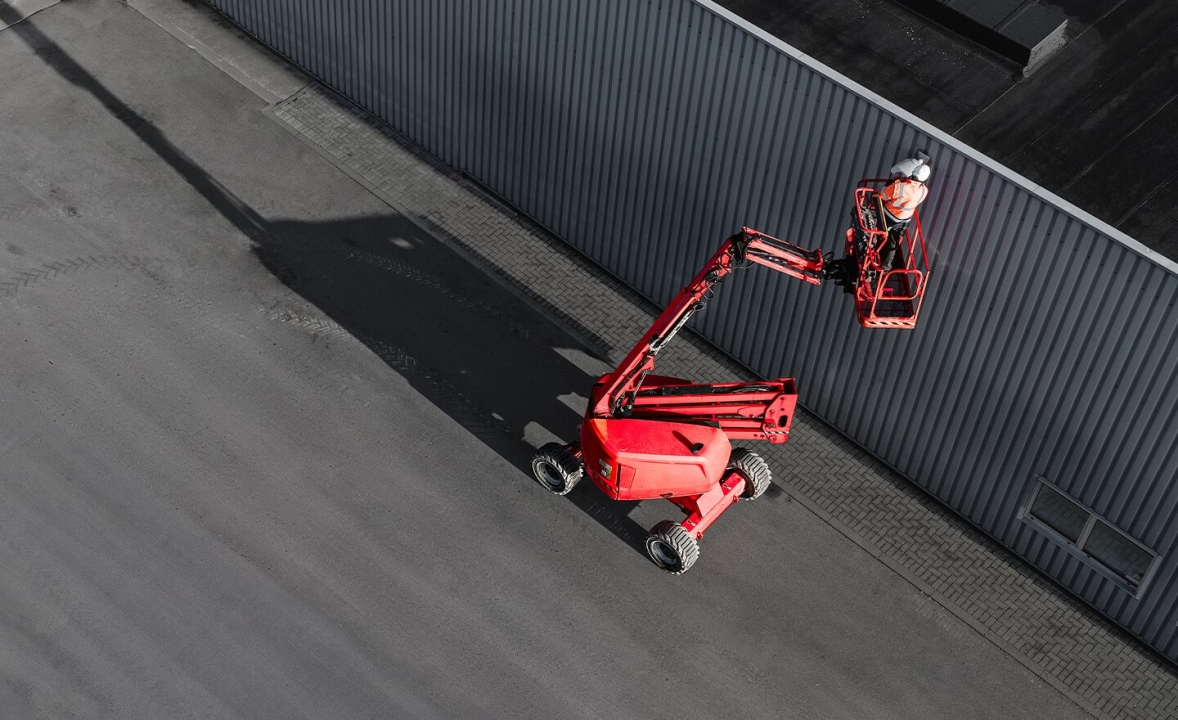
Red scissor lift with a safety-clad worker performing warehouse maintenance along an industrial loading bay, showing elevated access equipment and safe working conditions.

THE ARESTA PARTNERSHIP

TVH recently announced a product partnership with Aresta, a premium supplier of harnesses and safety gear specifically for MEWP users. How did the deal come about?

Gunther: The partnership with Aresta is the result of a thorough benchmarking exercise conducted by TVH several years ago, in which we critically evaluated multiple manufacturers on their quality, reliability and price. We deliberately sought out an established specialist who has been exclusively dedicated to fall protection.
 

Rik: Aresta has been doing business with major rental companies for years. They’re a strong brand with more than 20 years of experience and specialists who are fully up to speed on all the regulations. As a result, we now exclusively use Aresta for all fall protection on MEWP equipment.

What’s different about Aresta compared to other safety harnesses?

Rik: On top of the quality, the price for Aresta products is really good compared to other premium brands.
 

Gunther: Absolutely! And people can choose between separate accessories or complete kits, so they can get to work right away. Those kits contain the harness, shackles and lanyard; everything basically. They’re also a perfect match with the Harness ON™ system. Aresta stands out in the market because they offer a superior balance between certified safety and everyday comfort. Although their harnesses meet the strictest European standards, they weigh barely more than a lightweight harness. The harness’s design is such that the impact from a potential fall is not absorbed at the crotch. Instead, it’s distributed across the back via a
special triangular structure, which significantly reduces the risk of injury.

LOOKING AHEAD

If you could bust one major myth about MEWP safety or PPE that persists in the industry today, what would it be?

Gunther: As I pointed out earlier, people’s persistent assumption that the physical structure of the work platform alone provides sufficient protection. Too many operators assume they are safe simply because they are inside the guardrail of the aerial work platform.
 

Rik: That’s right, indeed. Many lives could be saved just by wearing the right PPE.

Looking ahead to the next 5 years, what do you think will be the next big frontier in MEWP safety? How is our company positioning itself to lead that charge?

Rik: TVH wants to continue focusing on universal innovations at the periphery of the machine. We want to collaborate with international specialists and invest in brand-independent protective equipment. Our aim is to protect every operator and work environment. We strive for an open innovation philosophy that makes the entire aerial work platform industry structurally safer.
 

Gunther: And when we look at the IPAF data, our focus should also be on preventing the rapidly rising number of entrapment accidents. This category is now approaching levels of traditional fall-related accidents in the statistics.

ABOUT THE AUTHORS

This blog post is brought to you by your MEWP team.

STEP 1
Tell us about your company

Submit the application form to specify your business needs and request your customer account.

STEP 2
Your account creation

Our sales team will contact you within 3 business days to talk about your business needs and complete registration.

STEP 3
Access our online shop

After your account is set up, you will receive a personal login to our online shop. We will guide you in finding parts and placing your first order.

Request your account

Over 75.000 customers trust TVH as their spare parts supplier to ensure their client’s equipment fleet is running smoothly and efficiently. It starts with a customer account.

Become a customer