The tech-driven future of small earth-moving equipment

19 May 2026

Since the global launch in 2020, TVH has more than tripled its turnover in the small earth-moving (SEM) segment. This growth comes at a time when machine manufacturers navigate through a volatile global supply chain, fueled by geopolitical trade shifts. Meanwhile, the industry is rapidly developing smart, automated machine features.

In this interview, Global Market Manager Joris Tijtgat discusses how TVH is adapting to a rapidly changing landscape. He explores the hurdles and opportunities of the industry and outlines the roadmap for the next frontier in construction parts and services.

Joris Tijtgat

About the expert

Joris Tijtgat is Global Market Manager at TVH. He has spent over 14 years at the company, rising from product development to his current role overseeing global strategic and operational market rollouts. Since 2019, he has spearheaded a major expansion that tripled turnover in the SEM segment.

MARKET EVOLUTION

What are the global trends you have noticed in the SEM equipment market over the last couple of years?

When looking at global trends in SEM equipment, I notice that manufacturers increasingly focus on technology. They are prioritising automation, AI and connectivity. Companies want to know exactly where their machines are at all times. It’s also hard to find technically skilled people in the current labour market, so manufacturers are adding technology to make these machines easier to operate.

Most of this technology originates from the heavy machinery sector. Just a simple example: many skid steer loaders come with a large display nowadays for grading. That’s the process of levelling and shaping land to establish precise slopes for construction projects. That’s a big technological leap compared to a few years ago; these machines aren’t the “simple” machines they used to be.

The second trend is the rise of Chinese manufacturers in Europe and the Americas. Chinese brands were already well-established in the forklift sector. In the construction market, however, all forecast models predicted a decline in machine sales in 2020. But as we know, that year was marked by the pandemic, which triggered a significant uplift in machine sales and led to record growth. Following this peak, the Chinese domestic market collapsed. This resulted in significant overcapacity and high stock levels, forcing Chinese manufacturers to move their focus toward the export market. As a result, we’ve seen these brands becoming much more dominant in the earth-moving sector.

Finally, a new type of machine, the mini track loader (also known as a stand-on loader), is becoming more popular. As a part of my role, I keep a close eye on these trends. If a certain brand or machine type gains ground, we must respond. The demand for spare parts for these new machines might not be high today, but it will certainly rise in the future. We need to ensure we have the right stock ready when that happens.

Over the last few years, you shifted TVH’s focus toward SEM product development and commercialisation. What actions did you take to make this happen?

That’s right. As Global Market Manager, I set the high-level strategy for the years ahead. I determine what we should focus on and how to roll it out internally and to the customer. My strategy is based on two pillars: product development and commercialisation. You must have the product to offer, but you must also know how to sell it.

To keep the foundations solid, I have worked hard over the past six years to support the sales team. TVH has been in the forklift parts business for a long time. Over the years, we also gained experience by expanding our product portfolio to include parts for telehandlers, MEWPs and agricultural equipment. So our commercial team already has good technical knowledge of various types of machines. For SEM however, we added many products that were completely new to us, including rubber tracks and undercarriage components. To be successful, we must have the right skills and knowledge. When you buy something, you want to talk to someone who really knows the product.

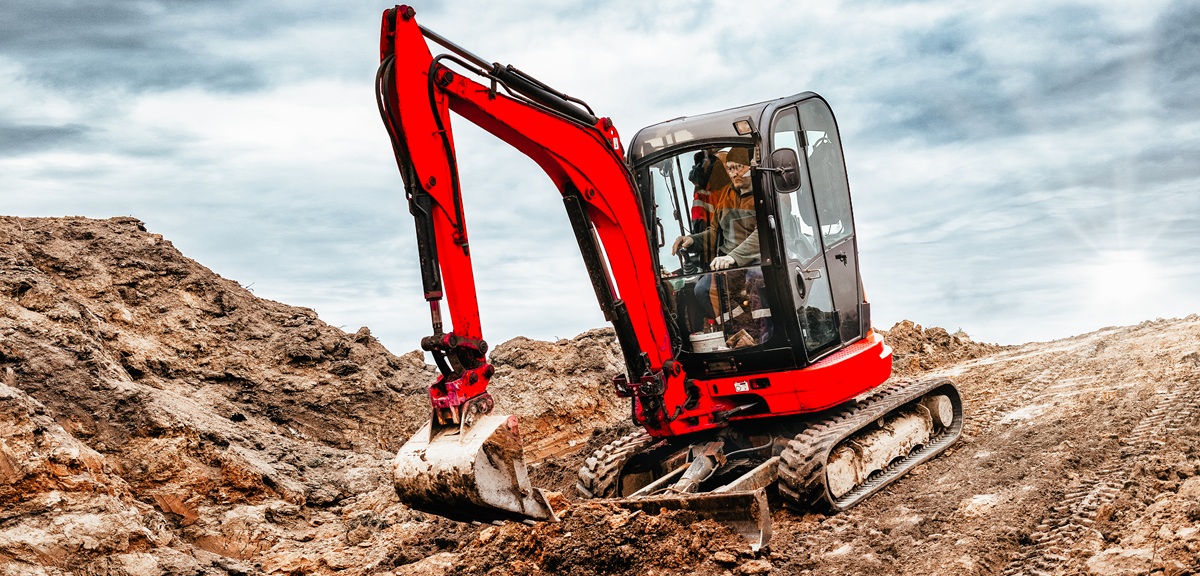
Mini excavator with rubber tracks

One important aspect of product development is anticipating future demand. Commercialisation is about creating a "go-to-market strategy"  where awareness is an important element. Our TVH logo features a forklift, so some construction equipment owners might not know we can be their partner. Six years after our launch, we still focus on creating awareness through trade fairs and advertising so customers make that connection.

We also focus on attracting new customers. Targeting a new market means reaching out to people who don’t know us. But we also analyse our current customer base and contact rental companies or repair shops that may also handle earth-moving equipment. With small earth-movers, there’s also an overlap with the agricultural sector. For instance, a farmer often uses a skid steer loader to muck out a barn. We must ensure these existing customers know we also support those machines.

Finally, commercialisation means getting the right part to the right place. Brands and certain equipment types can vary in popularity across the globe. For example, in South Africa, backhoe loaders are more popular than in France, where mini excavators dominate. With this knowledge, we must ensure the right parts are available at the right place. We must tailor the inventory to each region.

When selling parts, three main factors are at play: price, quality, and availability. Availability is key here. In construction, if you need to wait a week for a part, your machine sits idle and everybody’s waiting. That’s a situation the customer can’t afford. To reduce downtime, we optimise stock levels based on brand and machine popularity. In Australia, we recently launched local stock for rubber tracks. Previously, we shipped everything from Belgium. That was slow and the transport costs were high. Now, with local stock in places like Australia, Spain, and Italy, we can serve those customers much faster.

Sales for our SEM segment tripled following these actions. What are your next steps over the coming 12 months?

Things are moving fast in the SEM market. Over the next 12 months, we must continue to build on our foundations. We need to ensure our sales team has the right knowledge. Many new colleagues are starting, so we must repeat our training. There is a saying: "What gets repeated gets remembered, and what gets remembered gets done." You cannot blame new staff for forgetting, so repetition is vital.

We’ll also increase our awareness efforts by attending trade fairs and by improving our online presence. If, for example, someone searches for "spare parts for mini excavator", we must rank high in the search results. We’ll also improve our network so that we have the right parts in the right location. As mentioned earlier, we prioritise parts that are relevant to specific regions. Beyond that, we’ll follow trends like new manufacturers from China. 

Overall, the strategy for the next 12 months is to maintain the current momentum and to build on existing successes.

What is the impact of Chinese makes of SEM equipment becoming more easily accessible?

Chinese OEMs are definitely here to stay. There is a common perception that Chinese machines are less reliable than Japanese, American, or European models. However, these brands now use well-known, reputable components. You will find the same engines and hydraulic components in Chinese machines as you do in top Western brands. They identify what the leading brands use and incorporate those high-quality products into their own equipment. This builds trust with customers.

While early versions may have had quality issues, these manufacturers learn and improve very quickly. If they receive feedback that a function is not working well, they implement a fix almost immediately. This speed is a massive strength. They are also frontrunners in electrification, offering the industry's widest range of electric machines.

Availability is another key factor. While Western and Japanese manufacturers often have long lead times, Chinese OEMs often maintain large stock levels ready for immediate delivery. This availability often convinces customers to give them a try. 

The current tariffs in the US and Europe might act as a brake on the market, but they will not stop the influence of Chinese manufacturers. They are also building a significant presence in South America and Africa. We continue to monitor these brands closely to ensure we can support our customers in this growing segment.

TECHNICAL EXPERTISE AND PRODUCT EVOLUTION

How did TVH establish the right product selection for its SEM customers?

That’s a good question. It’s key to my role, and it is a complex process. The fundamentals involve investing time to know the market through data. We make choices by identifying the key brands and machines. However, talking to customers is even more important to me. You learn a great deal from their feedback.

There is no one-size-fits-all solution. It simply does not exist. We have chosen a general product range, but we adjust our choices for each local market.

With over 5 million part references now available for SEM, how do you ensure quality and compatibility across such a diverse multi-brand market?

Over the past six years, we have built a substantial database. You must first know the part numbers so customers can find what they need on our eshop. Creating such a large database is a significant milestone. Alongside those five million references, we have over 100,000 stock locations. That is quite substantial. 

It is certainly not straightforward. We do not just focus on filters or tracks like many competitors. We offer a wide range of products. That’s why we have dedicated product category managers. These product managers monitor their product lines and develop the necessary strategies. They determine what’s important for quality within their segments like hydraulics, tyres or engine components. On top of that, we employ many product experts globally. We support them with a strong quality team which gathers feedback and guides us. And last but definitely not least, we listen to our customers. They help us to make the right choices regarding product quality.

backhoe loader

What’s happening with electric compact equipment? Is the transition happening as expected? What are the potential hurdles?

Electrification is in full swing in the automotive and forklift truck sectors. For SEM, the use of electric equipment remains low. Forecasts for the construction sector are currently weak due to geopolitical factors and low government investment. High interest rates and fewer building projects also impact the adoption of these vehicles.

Another reason adoption has not taken off is the high purchase price. An electric mini-excavator can cost twice or even three times as much as a diesel model. And battery life is another concern. These machines often operate at remote sites without power, so they require expensive generators and chargers. For most, diesel still offers better value.

In Europe, countries like the Netherlands and those in Scandinavia lead the way because of government tax incentives. Without that support, the market struggles. We see a different trend with wheel loaders, however. These machines are a perfect entry point for electrification because their work is highly predictable. They typically perform short, repetitive tasks in controlled areas like industrial yards, so charging them is simple and efficient. Because these machines are in constant use, owners see a faster return on investment. This high utilisation makes electrification a scalable solution and is also why wheel loaders have become the most common electric construction machines on the market today.

The technology is available, but the market isn’t ready yet. Most customers cannot justify the price. The ones making those investments are rental companies. They need electric machines for contractors working in cities with strict rules on emissions and noise. Electric machines are very quiet, making them ideal for night work or repairs in densely populated areas. In that case, regulations make electric machines a necessity.

Technology is almost moving faster than a technician can learn. Where do you see the biggest knowledge gaps in the industry today, and how are we closing them?

Service technicians must keep a close eye on new technologies. We support our customers with diagnostic tools that work across multiple brands. For example, a technician can connect to several machines to check the engine or other functions. They can then identify the fault through a process of elimination and resolve the issues.

New players are continually entering the market, which might feel overwhelming at times. However, the core technology essentially remains the same. Internal combustion engines, for example, do get new features to meet lower emission standards. For that, we keep a close eye on technological developments together with TVH University. But most changes are not brand-specific; the technology remains the same.

We pay close attention to these developments through our training centre, TVH University. We’re expanding our courses to ensure we stay up to speed on products. Our partnerships with globally renowned partners also help us.

FLEET MANAGEMENT

How are present-day job sites changing the design of SEM equipment?

OEMs recognise that sites are becoming more compact due to urbanisation. They are responding with designs like the zero-tail-swing excavator. These machines can rotate 360 degrees without the upper body extending past the tracks. This allows them to operate in very tight areas.

Electrification is another major factor. Manufacturers must respond to new needs, such as requirements for low noise and zero emissions in cities. These standards did not matter ten years ago, but they are critical now.

At TVH, I closely follow these trends. When new machines become more popular, I must ensure we’re ready. Customers will eventually need parts, and we need to be ready to provide them. 

What’s the role of fleet management applications in all this?

Fleet management starts with recording working hours. It is the most accurate way to plan predictive maintenance. For small equipment, the tool also focuses on engine alerts and geofencing. For larger excavators, the focus shifts towards fuel consumption.

Our GemOne solution also helps customers protect their machines. The data allows them to determine a machine's exact location. This helps with logistics, but also addresses the ongoing issue of theft. Theft is a significant pain point in the earthmoving industry. This is not a new development; unfortunately, it’s part of everyday life. But GemOne does more than just that. It helps our customers to minimise machine downtime, reduce workplace incidents, and save time and money by tracking machines and monitoring their usage.

THE FUTURE

What is the next frontier for TVH in the SEM market over the coming years?

Entering the earthmoving business was a good choice for TVH; we had many spare parts compatible with the machines we already serviced, and there was significant overlap in our products and customers. That way, we could offer the earthmoving portfolio to many existing clients.
What’s unique is our clear boundaries. We focus on nine brands (Case, Caterpillar, Bobcat, JCB, John Deere, Yanmar, Kubota, Takeuchi and Volvo) and four machine types (backhoe loaders, compact track loaders, skid steer loaders and mini excavators). This covers 75% of the small earth-mover market, but we can also support our customers with other equipment, such as site dumpers and compact wheel loaders. The results show that our approach works, as we more than tripled our turnover. This is a credit to all the support teams who turn strategy into reality.

But our work is not finished. Looking ahead, I want to expand our portfolio. We can grow by adding more brands to our list. Our business is much more than just supporting customers with technical lookups and providing spare parts; we also offer services like TVH University and TVH Exchange, and we want to focus even more on improving e-commerce. Customers can now find parts, like rubber tracks, by searching for specific dimensions. We are testing new features to make the whole search experience even easier. 

We want to help more customers by being a single partner for all their needs. Whether they have Komatsu, Hitachi, or other brands, they should not need multiple suppliers. That is the ultimate goal.

LOOKING FOR SEM PARTS?

ABOUT THE AUTHORS

This blog post is brought to you by your SEM team.

STEP 1
TELL US ABOUT YOUR COMPANY

Submit this application form to specify your business needs and request your customer account.

STEP 2
YOUR ACCOUNT CREATION

Our sales team will contact you within 3 business days to talk about your business needs and complete registration.

STEP 3
ACCESS OUR E-COMMERCE SITE

After your account is set up, you will receive a personal login to our e-commerce site. We will guide you in finding parts and placing your first order.